Things I am building, mostly at the intersection of healthcare data and AI.
In progressWorking title · early prototype
Plainly
Find a health plan in Cambridge, MA or San Jose, CA that fits you, explained in plain language instead of insurance jargon.
Plan-comparison tools tend to bury people in detail. A student who has never compared a PPO
with an HMO should not need a glossary to pick a plan. I am building a simpler version to
see whether I can reproduce what those tools show, then add public data, like state
help programs, that they do not present in plain terms.
How it works today
Place & school
Age range
Household & job
Income range
Conditions
Budget
Matches
Every answer is a range or a broad category. No exact ages, incomes, diagnoses, or drug names.
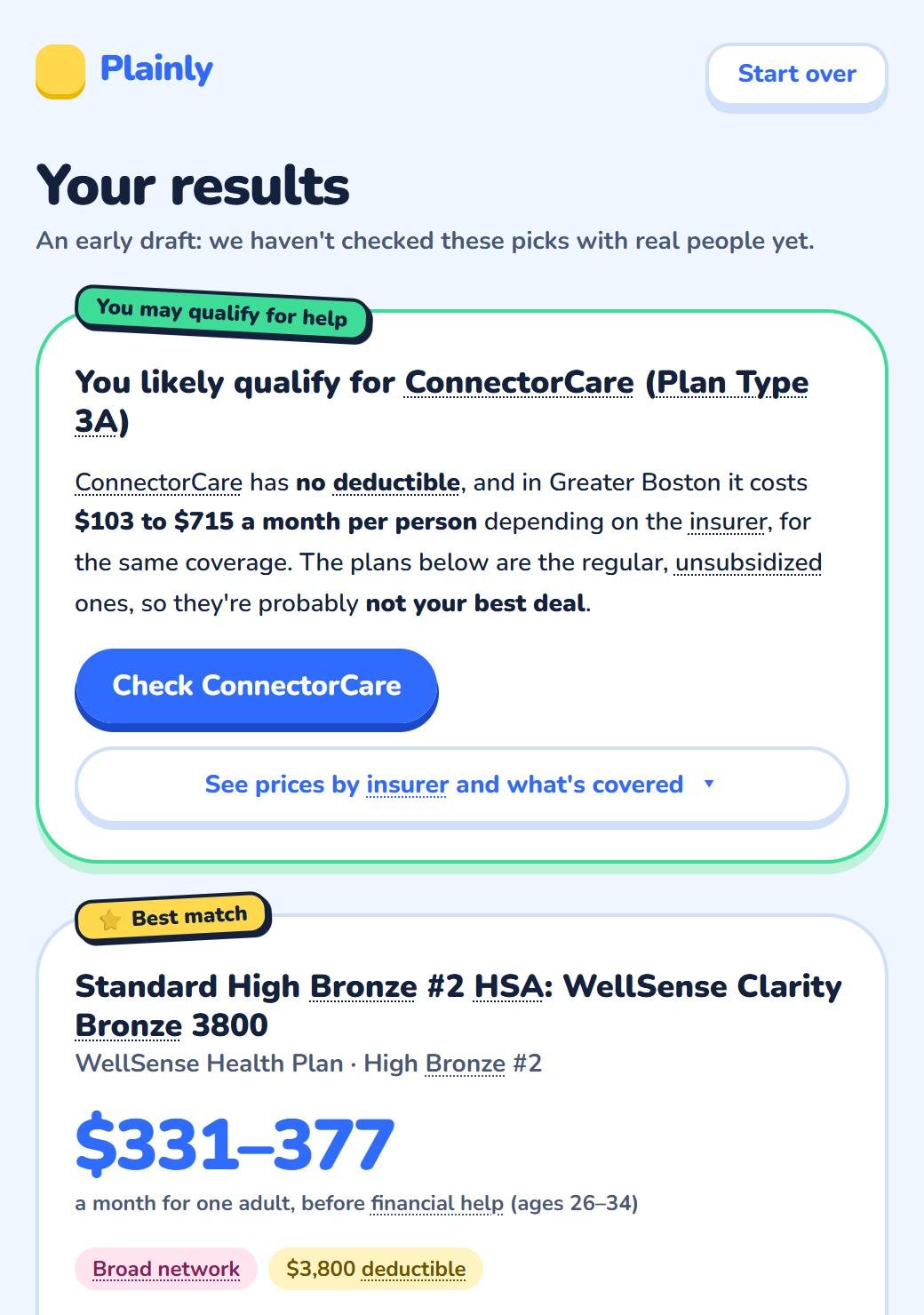
Results screen from the early prototype. Scores come from rules, flags state help when someone likely qualifies, and premiums are list prices for one adult before financial help.
Working
Plan matches in plain language, each with the reason it fits, a monthly price range, and what a doctor visit, ER trip, or generic prescription would cost. Flags state help, like Massachusetts' ConnectorCare, when someone likely qualifies.
Next
Testing with real users.
Open questions
Whether the right data exists at the city level, how best to generate the recommendations, and how to price a whole household instead of one adult.
In progressProduct brief · November 2026
med-map
Search a condition and learn whether a treatment can be bought directly today and where to find it nearby. If not, see how far clinical trials have progressed, in plain language.
Pipeline-tracking tools tend to be built for people already working in the industry, and
ClinicalTrials.gov is not written for lay readers. This is meant for patients, the newly
diagnosed, and the family and friends close to them, who want a plain answer to a simple
question: can I just go to a store for this, or is treatment still in development?
The planned first version
Condition
Direct-to-consumer options
Nearby map
Trial stage
Trial information comes first from ClinicalTrials.gov. No medical advice, user accounts, or insurance information.
Success
Conditions with known direct-to-consumer treatments return the right treatments and nearby sources. Conditions with treatments in development get a plain-language explanation of what stage each has reached.
Open questions
How the data gets checked, since a wrong treatment, location, or trial status could mislead someone. Whether a free, plain-language equivalent already exists. How much of the web to include beyond ClinicalTrials.gov.
More will land here as they ship. Questions in the meantime: pranavmg@mit.edu.